
The AI Customer Support Backlash: Why Companies Are Rowing Back
AI in customer support is having its self-checkout moment.
When self-checkouts first turned up in supermarkets, we were not amused. We resented the lack of appreciation of us as customers. We grew irritated waiting for human escalation (‘please wait while a colleague comes to help’). Why wasn’t a ‘colleague’ there in the first place. Over time though, most of us made peace with them. It’s even sometimes more convenient if it’s an easy shop, no booze or balancing everything on top of each other. Sometimes we don’t want a stranger looking over our shopping. But we won’t accept them because we have no choice. There are no humans unless we escalate and then it’s too late.
The crucial bit is choice. Self-checkout is fine when you have the choice. It’s infuriating when it is forced on us, and when we it fails.
AI support is suffering from the same self-checkout moment. Customers are not angry that AI exists or that its being used in support. It’s the fakery, the lack of choice, the need and time to escalate to a human.
Of course, to begin with, providers were excited. Every keynote, every board deck, every earnest LinkedIn post told the same story: contact centres would shrink, chatbots would become genius, and the tired old business of speaking to actual people would be painlessly retired.
The hyperbole and the reality
In December 2024, Gartner said 85% of customer service leaders would explore or pilot customer-facing conversational GenAI in 2025. More than 75% said they felt pressure from executive leadership to implement it. By February 2026, Gartner said that pressure had risen to 91%, while nearly 80% of organisations expected to reshape agent roles.
And then reality. In June 2025, Gartner said half of the organisations expecting to significantly reduce customer service headcount because of AI would abandon those plans by 2027, and that 95% of service leaders planned to retain human agents in a “digital first, but not digital only” model. In February 2026, Gartner added that only 20% of customer service leaders had actually reduced staffing because of AI. In September 2025, it predicted that none of the Fortune 500 would fully eliminate human customer service by 2028.
The dream looked better in slides than it did in reality. End-users were resentful and CSATs were down.
Forrester said in late 2025: 2026 would not be the year AI transformed customer service in some dazzling sci-fi leap. McKinsey was saying something close to the same thing in March 2025: yes, the contact centre of the future may be more AI-led, but the pace and path are uncertain, and leaders still have to make difficult decisions about how far to push automation while keeping the right balance between humans and machines.
In January 2026, Gartner predicted GenAI cost per resolution in customer service would exceed $3 by 2030, higher than many B2C offshore human agents, and that AI-related regulation would push assisted service volume up by 30% by 2028. So even the simple “AI will obviously be cheaper” story is starting to look flaky once you include governance, quality control, escalation, exception handling, and the rather annoying fact that bad automation creates more work somewhere else. Usually downstream. Usually with a human battling the consequences.
Customers never asked for an agentless future
One of the more revealing things about the AI support boom is how often it was discussed as if customers were desperate for it. They weren’t. As early as July 2024, Gartner found that 64% of customers would prefer companies not to use AI in customer service at all, and 53% said they would consider switching to a competitor if they discovered a company was going to use AI for customer service.
Their biggest concern was not some abstract fear of AI. It was much more practical. They were worried it would become harder to reach a human. Gartner’s own advice was that AI has to connect people to a human when needed and that the handoff has to seamlessly pick up where the chatbot left off. Which sounds blindingly obvious until you spend ten minutes in a bad support flow and realise how often companies still fail at it.
That wariness has not disappeared as AI has become more familiar. SurveyMonkey’s February 2026 customer service research found that:
- 79% of Americans strongly prefer interacting with a human over an AI agent
- 84% believe human agents are more accurate
- 81% think AI is used mainly to save money rather than improve service
- 89% think companies should always offer the option of speaking to a human
You do not get numbers like that if consumers are happily skipping toward the agentless future with a song in their hearts.
The UK looks very similar. 8×8’s October 2025 research found that 83% of UK respondents preferred speaking to a real person, while only 4% preferred a virtual agent or chatbot.
But there is an important nuance in the same survey: about one in three said they would choose AI if it meant lower prices. People are not intrinsically luddites. They are willing to trade toward AI when value is obvious. Speed, convenience, price, simple jobs. Fine. What they do not want is to be shoved into automation that saves the company money while making them feel trapped, repeated, delayed, slightly mugged off.
Yet there was a reduction in value for end-users. In March 2026, Gartner’s marketing survey found that half of U.S. consumers preferred brands that avoid using GenAI in consumer-facing content, and advised brands to make AI transparent, optional, and clearly helpful.
AI customer support – the psychological risk
Bad AI customer support asks questions that the system should already know. You are nudged down tidy little decision trees that bear no resemblance to the actual problem. You are made to repeat yourself because the first interaction did not really “count” as a proper interaction. The bot speaks like an over-trained intern trying to sound upbeat while you’re smashing your head against the desk.
Harvard Business Review got to the heart of this in 2025 when it decided that fixing chatbots is not really a technology thing. It is a psychology thing. Companies keep assuming that if the AI sounds more natural, the problem will disappear. But the issue is not language. People need the interaction to feel in their control. Once the reality hits that there is no way around the circular arguments of the bot, the battle is lost.
A 2023 paper in the Journal of Consumer Research found that customers evaluate service provided by bots less favourably than identical service provided by humans, in part because they infer that the firm is automating service to cut costs at the customer’s expense. A 2024 study in the Journal of Retailing and Consumer Services found significantly lower satisfaction, and willingness to recommend after chatbot interactions than after human-agent interactions.
And there are legal consequences. YouGov found strong majorities in multiple markets saying companies should be responsible for misinformation delivered through AI chatbots. The Air Canada bereavement-fare case made the same point the hard way: the company was held liable after its chatbot gave a passenger incorrect information, and the idea that the bot was somehow a separate entity did not get very far. Nor should it. The company owns the knowledge base that the bot is trained on. DPD had to disable part of its AI chatbot after a customer got it to swear and criticise the company.
The company inherits a real reputational risk. A bad bot is not merely a buggy tool. It is a public-facing expression of how seriously, or not, you take customer service. Even if AI did a better job than a human, the customer feels ripped off and unimportant if they cannot choose to use a human instead. The direct opposite of what customer support is supposed to do.
The customer support handoff – the weakest link
A customer speaks to the bot. The bot asks a few questions. The customer passes security. They explain the problem in painful detail. Then, after the bot fails, a human joins and begins with the emotional equivalent of wiping the slate clean. Name? Account number? Can you describe the issue? Have you already tried restarting the device?
AI-infused chatbots must connect customers to an agent as soon as they are asked and then seamlessly transform into an agent chat that picks up where the chatbot left off.
In March 2026, Booking.com’s customer-service leaders said the company was now using AI to work out what the customer needs and route them to the best channel, and to summarise context for agents before they pick up the conversation. The interesting bit was the admission that the company had historically preferred self-service because it was easiest for the company, and that customers often came back with the same issue because self-service had not worked, creating another ticket, another contact, another interaction. Booking.com admitted that tickets were being duplicated. The company described travel problems as stressful and said that human connection would be the differentiator. That is where the brand is judged.
AI customer support – notable detransitioners
Booking.com changed the way it handed off to humans. Klarna, who talked so loudly in the first place making aggressive claims about AI handling the work of hundreds of agents, later rowed back to beef up human customer service again. Its CEO said the earlier emphasis on cost had led to lower-quality support and that there should always be a human available if the customer wants one.
Verizon made a similar move when it launched its AI-powered customer-experience overhaul. After a short learning experience, it announced dedicated human “Customer Champions” for complex issues, 24/7 live support, 24/7 live chat, and continued access to human support.
The companies taking AI seriously are not the ones trying hardest to erase humans, rather the ones pairing AI with more visible human support.
Home Depot’s recent (March 2026) AI voice rollout replaced old phone menus with a voice agent that can answer common questions faster and more naturally, but it later stressed quick access to a human associate when needed.
As the AI enthusiasm wore off…
ServiceJi has been delivering support since 2005, with a UK-led model delivering outsourced service desk and help desk support from our India offices, with 24/7/365 coverage, and a public emphasis on combining skilled human support with automation rather than treating automation as a substitute for care or accountability.
Our model is structured, ITIL-aligned service management with human support at the centre and automation used to improve efficiency, service quality, and cost control.
At ServiceJi, we have seen clients come to us after the first wave of bot enthusiasm wore off. The pattern became familiar as the tickets reaching the human team was more frustrated and less trusting. The CSAT damage was repeat contacts points, painful escalations, sourer sentiment, and users who felt they were being cheated.
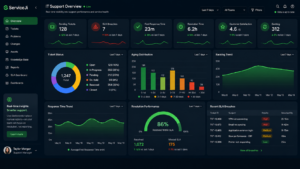
ServiceJi’s support metrics back up the claim that human-led, well-designed support, giving end-users the option of AI ‘tier 0’ assistance, can be both efficient and high quality. First-contact resolution hovers around 85%, average resolution time is 30% faster than industry averages, CSAT is consistently above 90%, NPS averages over 60, and SLA compliance exceeds 95%. These are the numbers arguing that human support, with automation in the right places, performs.
ServiceJi’s public case-study material includes 24/7 help desk operations and structured support work for public-facing digital platforms, such as Honor Education, HSBC CMS support & Mercedes-Benz platform support, where continuity, availability, governance, and reduced internal workload demand the human touch.
Our clients in any case don’t suffer the same cost differential between human and AI support as our customer support is delivered from our cost-efficient base in India.
AI earns its keep if it stays in its box
AI can classify tickets, suggest knowledge articles, route online requests, summarise previous interactions, and assist agents with the sort of repetitive admin that drains time. Booking.com is using AI to understand what a customer needs at first contact and to summarise relevant context for agents with a seamless handover. Verizon is using AI in the app while offering named human ownership. Home Depot is using AI to handle common questions more quickly. For the IT service desk implementation details, see our service desk automation guide, including six practical workflows, cost calculations and a 90-day pilot plan.
A mature service desk can absolutely use automation and AI-assisted tooling as self-service option. ServiceJi’s own metrics point to faster resolution and stronger SLA performance. That is the grown-up use of AI: speed up what is boring, structured, or repetitive so the human being has more time and more context when the problem gets interesting.
In an increasingly automated world, the human touch stands as a differentiator. The customer needs to perceive that a human, someone on the same level as they are, owns the problem. We need to know that the person on the other end of the line empathizes, and, at least to date, machines cannot empathize.
So what to do?
Add AI as an optional self-service checkout. If the customer is speaking to AI, it shouldn’t pretend otherwise. It shouldn’t cosplay behind a faux-human name and annoying cheerfulness. We can all recognise AI written content. We see it in our inbox every day where all emails sound the same and blog posts written by AI, all with the same safe monotone voice. Make the AI transparent and optional. Continuity matters, so ensure a seamless hand over.
Treat your employees with the same care as your customers. An employee locked out of a critical system at 8:10 in the morning does not care that the bot has impressive natural-language capabilities if it still cannot get them into the application they need to do their job. A service desk user dealing with a broken laptop, a failed MFA reset, or a messy permissions issue does not want a soft, soothing conversation with a machine that keeps pretending it is close to helping. They want the problem sorted or a human option.
ServiceJi helps our clients design support models that use automation where it genuinely improves speed and consistency, while keeping human expertise always available for judgment, empathy, continuity, and a perception of real accountability. That can be a mix of service desk outsourcing, outsourced IT help desk support, out-of-hours cover, 24/7 operations, or a co-managed customer support model that gives your internal team breathing room without sacrificing service quality. ServiceJi’s positioning across those services is consistent: structured, measurable, human-led support, with automation for those that secretly love that self-service checkout experience.
The small print…
If AI ever reaches ‘Artificial General Intelligence’, which means that it learns and performs everything better than humans, then remember that this article was written before The Rise of the Machines. If that happens, I think you will agree, all bets are off.